
How the Nurse Licensure Compact (NLC) Works in 2026
Mobility is at the heart of travel nursing, but that mobility depends on understanding exactly where and how you’re legally allowed to practice. As of 2026, the Nurse Licensure Compact (NLC) has continued to evolve, with new states fully joining, implementation timelines shifting, and clearer guidance on relocation and residency. In 2025, the NLC also marked its 25th anniversary, reinforcing its long-term role in expanding nurse mobility while continuing to refine governance and administrative guidance across participating states.
Whether you’re planning your next assignment, considering a permanent move, or simply want to avoid licensing surprises, staying current on the NLC is essential to keeping your career moving without interruption.
What Is the Nurse Licensure Compact (NLC)?
The Nurse Licensure Compact (NLC) is an agreement among participating states that allows registered nurses (RNs) and licensed practical/vocational nurses (LPNs/LVNs) to hold one multistate nursing license and practice in other compact states without obtaining additional licenses. The compact was created to improve access to care while giving nurses the flexibility to move where demand is highest, something especially valuable for travel nurses.
The NLC is coordinated by the National Council of State Boards of Nursing, which works with state boards of nursing to maintain shared standards for licensure and practice.
A multistate nursing license allows nurses to practice across participating states in person or via telehealth, but it is not a national license. Eligibility depends on living in a compact state, and nurses must follow the laws of the state where the patient is located. For nurses whose primary residence is in a non-compact state, individual state licenses are still required to practice elsewhere, meaning a compact nursing license may not be available unless residency changes.
How Multistate Licensure Works
To qualify for a multistate nursing license, a nurse must legally reside in a compact state and apply through that state’s board of nursing. That state becomes the nurse’s primary state of residence (PSOR) and issues the license that grants practice privileges in other compact states – a key advantage of the NLC for travel nurses seeking flexibility.
Because compact states share licensing standards, they can recognize each other’s licenses while maintaining patient safety requirements. This shared framework significantly reduces administrative barriers for travel nurses, allowing them to move between assignments faster and with less paperwork.
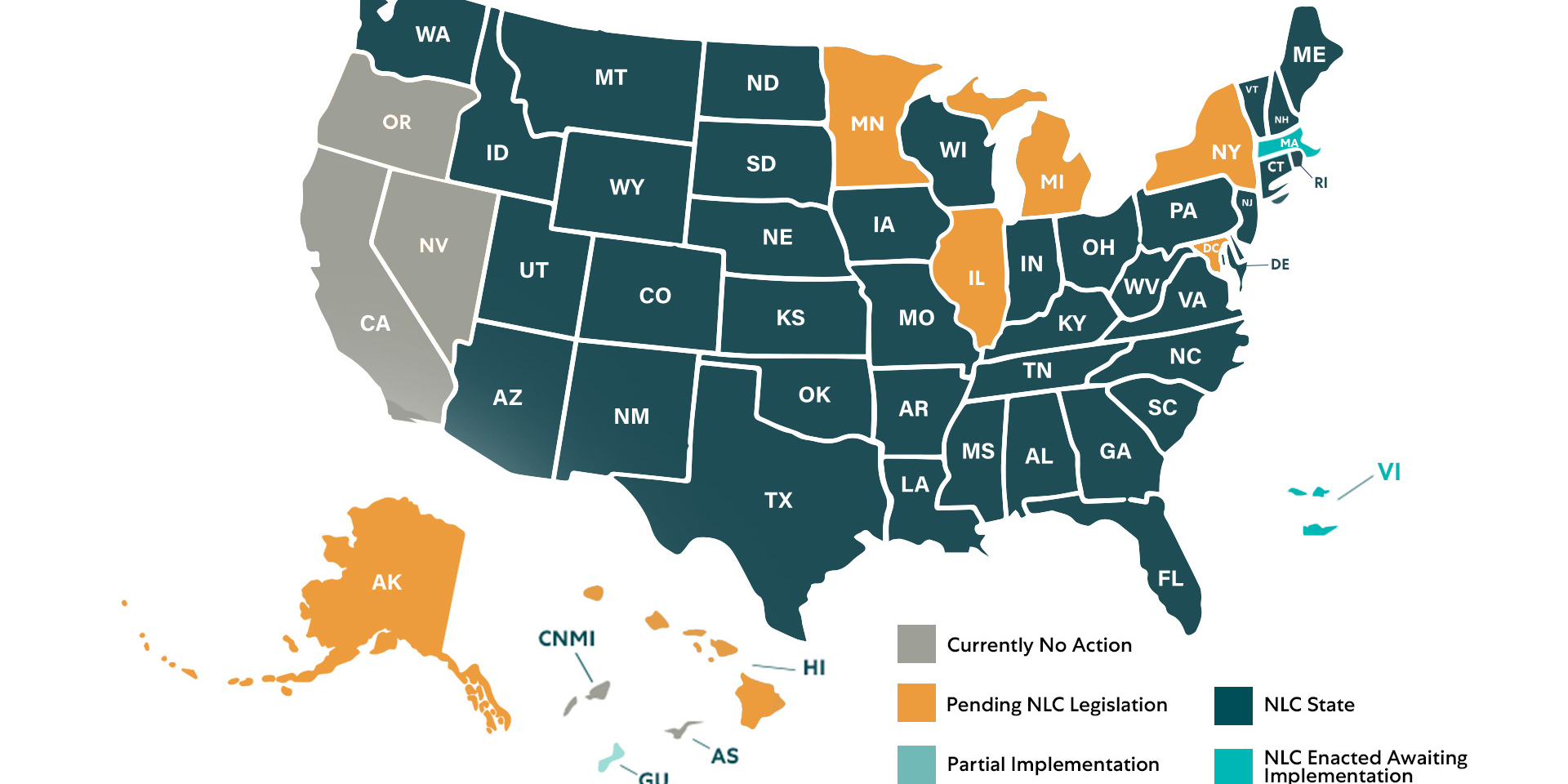
As of 2026, roughly 40 states participate in the Nurse Licensure Compact, and the map continues to expand. Because participation can change, travel nurses should always confirm the latest status through the Interstate Commission of Nurse Licensure Compact Administrators before relocating or accepting assignments.
What’s New in 2026
Several important changes and clarifications continue to shape how travel nurses navigate the NLC. Here are the highlights with most relevant updates and what they could mean for travel nurses today.
New States Fully Implemented
One of the biggest updates is that Pennsylvania fully joined the compact in July 2025. Nurses who legally reside in Pennsylvania can now obtain multistate nursing licenses, and nurses from other compact states can practice there under their existing multistate privileges.
Connecticut also implemented the Nurse Licensure Compact in 2025, expanding access in the Northeast and opening additional assignment opportunities in a region that previously had fewer compact states.
Continued Expansion and Pending States
Several additional states have enacted NLC legislation, but are still working toward full implementation. This means the compact map is likely to keep expanding in the coming years, making it increasingly important for travel nurses to verify a state’s current status before relocating.
Clarifications on the 60-Day Rule
The NLC 60-day rule remains in effect, but guidance has become clearer regarding when the timeline begins. It is now widely emphasized that the clock starts when legal residency is established, not simply when a nurse arrives in a state for an assignment.
Growing Importance of Telehealth Practice
As telehealth has continued to grow, and the NLC’s role in supporting cross-state remote practice has become even more significant. However, nurses must still be licensed in the state where the patient is located. Holding a multistate nursing license does not automatically allow practice in any state where a patient may reside. The license is valid only in participating compact states where the nurse is legally practicing. This clarification is especially important for travel nurses providing telehealth services or working in hybrid roles.
The NLC 60-Day Rule Explained
The NLC 60-day rule applies to nurses who relocate permanently to another compact state.
If you hold a multistate nursing license and change your primary state of residence, you must apply for a new multistate license in your new home state within 60 days of establishing residency. This aspect of the NLC relocation rule ensures that the licensing authority follows your legal home state while preserving your ability to practice across compact states.
When the 60 Days Begin
The timeline starts when you establish legal residency, not simply when you move or begin working. Establishing residency typically involves formal actions that demonstrate intent to make the state your permanent home, such as obtaining a driver’s license, registering to vote, or filing taxes as a resident.
This distinction is especially important for travel nurses, who may live in a state temporarily while maintaining permanent residence elsewhere – a common scenario addressed by the NLC for travel nurses.
How the Nurse Licensure Compact Affects Travel Nurses
For most travel nurses, the compact continues to provide significant flexibility. If your assignments are temporary and you maintain your permanent residence in your home compact state, you can generally practice in other compact states under your existing multistate nursing license without taking additional action.
Temporary assignments alone do not change your PSOR, even if you live in another state for several months.
When Travel Assignments Become Permanent Moves
If you decide to settle in the state where you were traveling – whether by accepting a permanent position, purchasing a home, or otherwise establishing residency – that state becomes your new PSOR. At that point, the NLC relocation rule applies, and you must apply for a new multistate nursing license there within the NLC 60-day rule timeframe.
Accepting a job offer alone does not trigger the rule; the requirement applies only when your legal residency changes.
Special Scenarios Travel Nurses Should Understand
Travel nursing careers often involve complex situations, and the Nurse Licensure Compact provides guidance for several of them.
If you relocate to a state that has not yet implemented the compact, you may need to apply for a single-state license until a compact nursing license becomes available. If you move but do not plan to continue practicing nursing, you are not required to obtain a new multistate license, though you should notify your former state board of your residency change.
Timing also matters if your license is close to expiring. Renewing before relocating can help prevent interruptions to your ability to practice, an important consideration for travel nurses planning back-to-back assignments.
Pending Implementation States and What That Means
While the compact continues to expand, not every state that has passed NLC legislation has fully implemented it. Some states have enacted compact laws but are still finalizing regulatory alignment, background check systems, or administrative processes before issuing multistate licenses.
For travel nurses, this distinction matters. A state may appear on a legislative map but not yet grant compact privileges. Before accepting an assignment or relocating, confirm whether the state is fully implemented or still pending. Implementation status determines whether you can practice under your existing multistate license or must apply for a single-state license temporarily.
Practicing While Your New License Is Processing
Once you establish a new primary state of residence and apply for a multistate nursing license in that state, your ability to practice under your previous license may be affected. You must confirm with the new state board of nursing whether you can continue working while your new license is being issued, as rules and temporary approvals vary by state. Ensuring compliance during this transition helps prevent disruptions to your assignments and maintains your legal ability to practice.
Telehealth and Multistate Practice
Telehealth continues to expand, and the Nurse Licensure Compact applies to remote practice as well. Nurses providing telehealth services must be licensed in the state where the patient is located, not just where the nurse is physically working. For travel nurses taking hybrid or remote roles, this requirement can affect which opportunities are available under a multistate nursing license.
The Nurse Licensure Compact: What It Means for Travel Nurses Today
The Nurse Licensure Compact (NLC) continues to be one of the most powerful tools for travel nurses seeking flexibility, stability, and access to opportunities nationwide. As the compact expands and guidance becomes clearer, understanding how multistate licensure, residency rules, and the NLC 60-day rule work together can help you avoid disruptions and move confidently between assignments.
Importantly, the Enhanced Nurse Licensure Compact framework remains in place, with no federal overhaul or replacement structure introduced. That stability allows nurses and employers to rely on a consistent multistate licensure model even as additional states join.
Whether you’re staying mobile or planning a permanent relocation, staying informed ensures your career keeps pace with your ambitions. In a profession defined by movement, the NLC is what keeps travel nurses ready to go wherever they’re needed most.
If you have questions about the Nurse Licensure Compact or how it applies to your unique situation, Epic Travel Staffing is ready to guide you. Our expert recruiters understand the ins and outs of multistate licensure, helping you navigate assignments and relocations with confidence. Reach out today and let us help you take your nursing career wherever it can go.